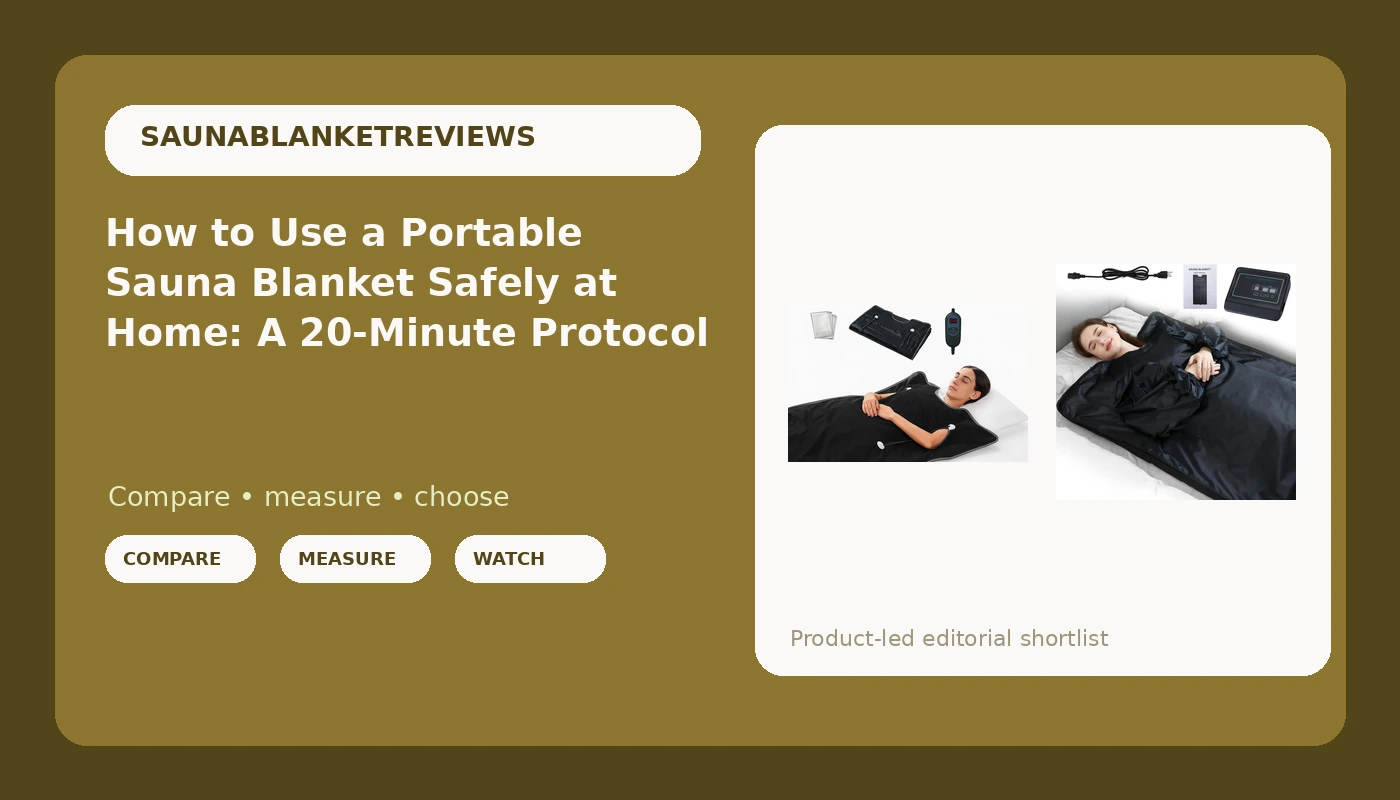
Most people who buy a portable sauna blanket get about three weeks of good use out of it and then stall out. It is almost never the heating element that fails them. It is the routine. No protocol, no timer discipline, no cleanup habit, and the blanket ends up folded in a closet next to a yoga mat.
I have been running heat sessions since 2022, when my own shoulder surgery recovery stalled and I went looking for something that fit in a small apartment in Boulder. I have logged nine blankets since then. I weigh myself before and after every session, because sweat volume in grams is the only honest metric in this category, and I write down temperature, heart rate, and how I slept.
This guide is the how-to part: how to run a session on a portable sauna blanket without burning yourself, killing the zipper, or quitting by Thanksgiving. It also covers the two blankets I would hand a first-timer right now, one as the entry point and one as the step up, and the specs I check before I plug anything in.
Why you should trust me
I am a recovery coach, not a doctor. I work with CrossFit athletes and weekend warriors who want to sleep better and feel less beat up, and heat is one of the tools in that kit. I was a competitive swimmer for 14 years before that, so I came into this with a high tolerance for being uncomfortable and a low tolerance for gear that lies about what it does.
The blanket log started as a way to answer one question honestly: does 20 minutes, four times a week, measurably change how fast I fall asleep? Six months in, I have data on my own sessions and notes on eight other blankets I have owned or borrowed. I have killed two of them at the zipper, not the heating element. I have a small scar on my forearm from a cheap blanket with a dial that had no timer, which is why auto-shutoff is a hard rule for me and not a nice-to-have.
Two boundaries I hold. I do not make detox or weight-loss claims, because the research does not support them and the marketing around them is dishonest. And I do not advise pregnant people or anyone with a heart condition about heat exposure. That conversation belongs with your doctor.
How I picked and how I tested
I judge every blanket against the same checklist, in this order:
- A countdown timer with auto-shutoff. No exceptions. A blanket that only has a temperature dial is a burn risk the moment you fall asleep.
- Heat distribution. Even heat matters more than peak heat. A blanket that hits 160 degrees at the chest and 120 at the feet is a broken product, no matter what the box claims.
- The zipper. It is the most failure-prone part on the whole unit. I look for a zipper that runs smoothly without catching fabric and a pull that does not feel like it will snap in month four.
- Fabric and smell. Oxford-style shells wipe down and do not hold sweat. Plush linings feel nicer on day one and smell like a locker room by month two.
- Cleanability. If the cleaning instructions require a PhD, the blanket will not get cleaned, and an uncleaned blanket is a skin problem waiting to happen.
- Size against your body. You want the blanket long enough to cover shoulders to ankles with room to move, and wide enough that your arms are not pinned.
Full disclosure on method: I have not run a six-month durability log on the two blankets below. Where a claim rests on the manufacturer's spec rather than my own logbook, I say so. What I can tell you is which specs hold up in practice and which ones are decoration.
The two blankets I would start with
These are two different answers for two different buyers. One is for the person who wants to find out whether they will actually use a blanket before spending real money. The other is for the person who already knows they will, and wants the control features that keep a session safe and repeatable.
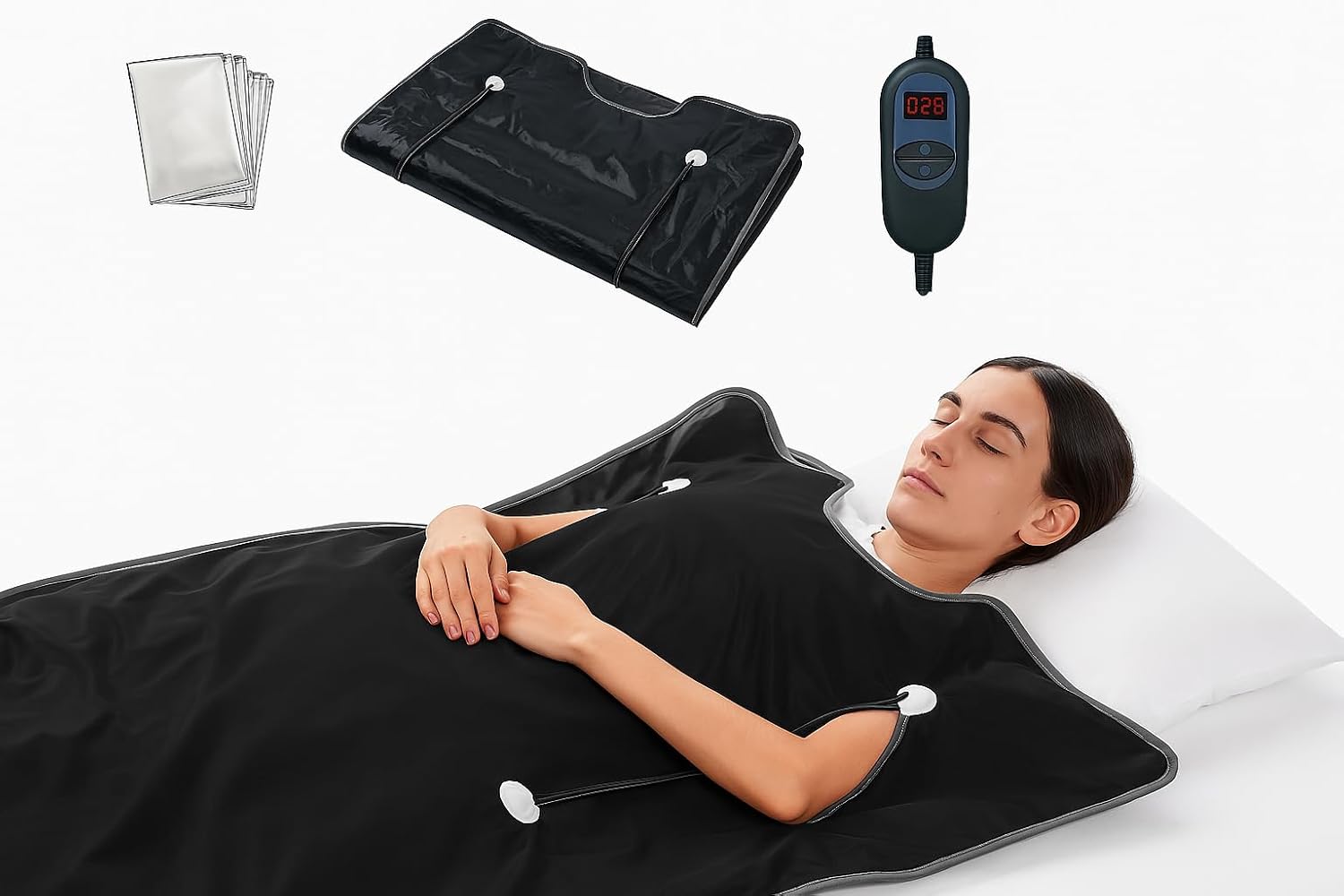
Budget pick: American Wellness Authority Infrared Sauna Blanket - Portable Sauna Blanket for Home Deep Sweat & Refresh with Adjustable Temp 95-176°F. 400W 70" x 31" 1, Oxford Fabric
 Visit on Amazon →
Check current Amazon price. This is the one I point at when someone wants to test the habit without a big commitment, and the spec sheet supports that role. The 70 by 31 inch footprint covers most adults lying flat with arms inside the seam, and a 400W element is in the range where a blanket reaches its set temperature in a reasonable time instead of leaving you cold for the first ten minutes.
The adjustable window runs from 95 to 176 degrees. In practice I spend nearly all of my sessions between 120 and 150, so the top end is there for people who like it hot, not because you need it. The Oxford fabric is the practical part: it wipes down, it does not soak up sweat the way a plush lining does, and it does not turn into a pet-hair magnet.
Flaws but not dealbreakers: The feature set here leads with temperature range and wattage, and I could not confirm a countdown timer from the product listing I reviewed. A blanket without a timer is the one category I will not hand a client, because the failure mode is dozing off inside it. Before you buy, confirm the controller has a countdown that shuts the heat off on its own. If it does, this is the least expensive honest entry into the category.
Anyone on a tight budget who wants to prove the habit before upgrading should start here.
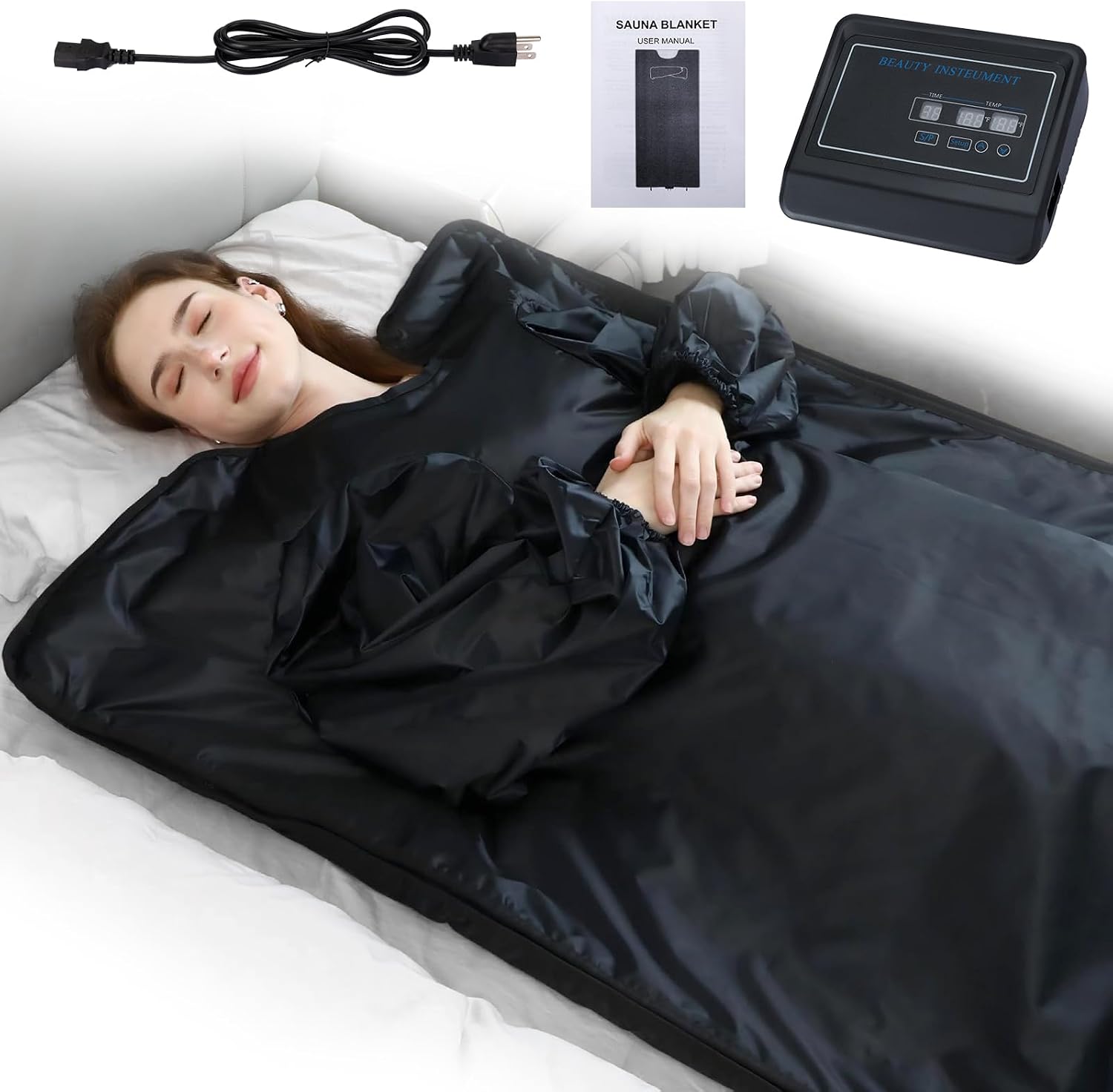
Upgrade pick: Lcoco&Dream Portable Sauna Blanket for Home, Double Sided Temperature 90-180℉ Temperature,30-90 Minute Timer with Remote, Foldable Washable Design and Storage Bag,6 x 3 FT
 Visit on Amazon →
Check current Amazon price. The 30 to 90 minute timer with remote is the reason this is my pick for anyone who is serious. That timer is the safety feature that makes everything else possible: you set the ceiling before you get in, and the blanket enforces it whether you are still awake or not. The double-sided temperature design gives you two zones to work with, which is what you want when your upper back needs more heat than your legs do.
At 6 by 3 feet, this is the larger of the two, and the extra length matters if you are tall or you like your arms inside the blanket. It folds down and ships with a storage bag, so it does not have to live on your bed. The washable design is the other feature I care about, because a blanket you can actually clean is a blanket you will keep using past the three-week wall.
Flaws but not dealbreakers: Two things to verify. First, confirm whether "washable" means the entire blanket goes in the machine or whether it refers to a removable liner, because the answer changes how you care for it. Second, ask yourself about the remote. A remote-controlled unit will beep, and a beeping controller at 3 a.m. is a specific kind of annoying. Keep the remote on the nightstand and set your session earlier if that bothers you. The 180 degree ceiling is more than anyone needs, so treat it as headroom rather than a target.
Anyone who wants timer control, a longer footprint, and a blanket that stores away should look here first.
What I left off this list
I skipped a lot of blankets to land on these two, and the reasons are consistent. Anything without a timer is out, regardless of how hot it gets. Anything that advertises a maximum temperature without publishing anything about heat distribution is out, because peak heat is the easiest number to fake and the least useful one to own. Anything with a zipper that catches on the fabric when I close it is out, because I have watched that exact failure end two blankets in under a year. And anything that smells like a chemical plant for the first three weeks is out, because off-gassing is not a personality trait you should have to tolerate in your bedroom.
The session protocol, step by step
Now the part that actually determines whether you get anything out of this.
Step one: Set the room before you set the blanket. You want water within reach, a towel between you and the blanket, and a clear path to stand up. Lay the blanket on a flat surface you can get off of easily. Put your phone in another room. The session is 20 minutes of doing nothing, and that is the point.
Step two: Dress for it. Light cotton or nothing at all. Skip lotion, oils, and deodorant, which can interact with heat and leave residue in the fabric. Take off metal jewelry before you zip in.
Step three: Weigh in, if you want the data. Same scale, same time of day, before and after, and log the difference in grams. This is the only number in the category that does not lie to you. Just understand what it means: it is water, not fat. You will drink it back within a couple of hours.
Step four: Start lower than you think. For a first session, set the blanket near the bottom of its range and run 15 to 20 minutes. I start clients around 110 to 120 degrees. You can always add heat next time. You cannot un-cook yourself.
Step five: Set the timer and trust it, not yourself. This is where the auto-shutoff earns its place. Set 20 minutes, get in, and let the blanket end the session for you.
Step six: Stay awake. No napping inside the blanket, no alcohol beforehand, and skip it entirely if you are on cold medicine or anything that dulls your sense of heat. The people who get hurt in this category are the ones who fall asleep.
Step seven: Come out slowly. Unzip, sit up, and give yourself five to ten minutes before you stand and walk. Cool down before you shower, and drink water.
Step eight: Wipe it down every single session. A damp cloth on the inside surface, then let it air dry fully before you fold it. This takes 60 seconds and it is the difference between a blanket that lasts and one that smells.
Step nine: Log it. Temperature, minutes, weight delta, and how you slept that night. Four sessions a week for a month gives you a pattern you can actually read, which is more than any marketing page will tell you.
Safety rules I will not bend
- If you are pregnant, have a heart condition, take blood pressure medication, or have any condition that affects how you regulate temperature, talk to your doctor before you use a blanket. This is not a guideline, it is the line.
- Never use a blanket that lacks auto-shutoff.
- Never fall asleep inside one.
- Cap sessions at 40 minutes. Longer is not better, it is just hotter.
- Get out immediately if you feel dizzy, nauseated, or lightheaded.
- Do not use a blanket on broken or irritated skin.
- Never run one on a surface where you cannot get up quickly, and never on top of another heat source.
Cleaning, drying, and storage
Wipe the interior after every session and let it dry open, not folded. Deep clean according to the manufacturer's instructions for your specific model, and check whether your unit's washable claim covers the whole blanket or only a liner before you put anything in a machine. Store it folded and dry in the bag if it came with one, somewhere out of direct sun and away from anything that runs hot. If the zipper starts catching, stop zipping past the snag and clear the fabric. That habit alone has saved two blankets for clients of mine.
What this actually costs you
The money math in this category is simple, and it is not the interesting part. The interesting part is the time math. Twenty minutes in the blanket, five minutes of cleanup, and a few minutes of cooling down is roughly a half hour per session. Four sessions a week is two hours. Compare that to the drive, the parking, and the locker room at a drop-in sauna and the blanket wins on convenience by a wide margin, which is the entire reason the category exists.
The real cost is the replacement cycle. A cheap blanket that dies at the zipper in eight months costs you more per session than a better-built blanket that lasts three years, and it costs you the habit, because most people do not buy a second one after the first one breaks. Buy the timer. Buy the zipper that closes cleanly. Then run the protocol.
The short version
Set the room, start low, set the timer, stay awake, come out slow, wipe it down, and write down what happened. If you want the entry point, the American Wellness Authority blanket is the cheaper way to test the habit, provided the controller has a countdown timer. If you want the timer, the longer footprint, and the storage bag, the Lcoco&Dream is the one I would hand a client. Either way, the blanket is not a sauna. It is heat therapy on your couch, and it works well when you treat it that way.