Most people learn how to use a sauna blanket the hard way. They unbox it, crank the dial to the highest number, climb in, and fall asleep. Then they wake up dizzy, dehydrated, and mildly overcooked, and the blanket ends up in the closet next to the ab roller. I have watched that cycle happen with clients more times than I can count.
I'm Tessa, a recovery coach in Boulder, Colorado. I work with CrossFit athletes and weekend warriors, and I started using sauna blankets in 2022 when my shoulder surgery recovery stalled and I needed consistent heat I could get without driving to a gym. I have run nine blankets over three years. I weigh myself before and after every session to measure sweat loss, and I keep a logbook with session length, heart rate, and how quickly I fall asleep that night.
One thing before the steps, because it saves people money: a sauna blanket is not a sauna. It is heat therapy on a couch. Buy it for what it is and it earns its keep. Buy it expecting a cedar cabin, a bucket of water, and a cold plunge, and you will be disappointed by week two. What follows is the protocol I hand to clients, the two blankets I would start most people on, and the safety lines I will not cross.
Why you should trust me
I have put nine blankets through the same routine since 2022: four sessions a week, 20 minutes a session, weight in before, weight out after, and a note on sleep onset that night. I have killed two blankets, and both died at the zipper, not the heating element. That single detail is why zipper quality is the first thing I look at and the last thing I stop talking about.
My background is recovery coaching, not medicine. I have a self-experiment running on whether 20-minute sessions four times a week measurably improve how fast I fall asleep, and I'm six months into it. I also know where my lane ends. If you are pregnant, if you have a heart condition, a pacemaker, blood pressure medication, or diabetes with neuropathy, this article is not your clearance. Talk to your doctor first, and take their answer over mine.
I also do not sell detox. The word shows up on a lot of product names in this category, including the ones below, and I will not repeat it as an outcome. Sweat is water and electrolytes. Recovery and sleep are where the real evidence lives.
How I picked and how I tested
This article is about running the protocol, not about crowning a winner, so the two blankets below are here because they cover the two ends of what a normal buyer actually needs: an entry price point and a wider, heavier build. Everything in the steps section works on either one.
What I look at on any blanket is the same short list. First, the timer. A temperature dial without auto-shutoff is a burn risk, and I will not recommend a blanket without one. Second, heat distribution: a blanket that runs hot at the chest and cool at the feet is a broken product no matter what the max temperature says on the box. Third, the zipper, because that is the part that fails. Fourth, cleaning instructions, because if keeping it hygienic takes an hour, you will stop using it.
What I do not trust is a max-temp number with no distribution data behind it. I check the chest and the feet during a session, I watch how the blanket behaves when it is folded under a body, and I read the cleaning and storage instructions before I read the marketing copy.
The two blankets I would start with
Both of these are blankets I would put in front of a client, for different reasons. Neither is a medical device, and neither one replaces a real sauna if a real sauna is available to you.
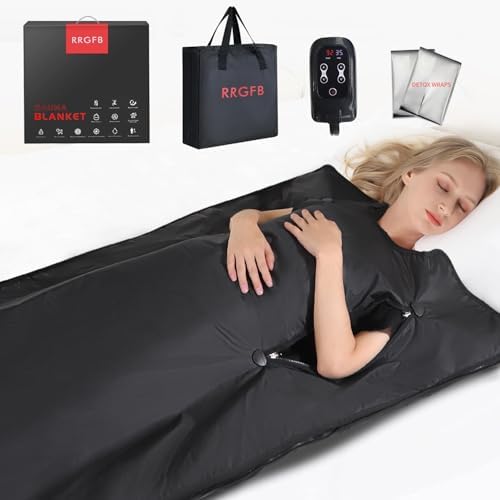
Budget pick: Infrared Sauna Blanket for Home Detox, Portable, 6 ft x 2.6 ft
 Visit on Amazon →
This is the shape most people picture when they picture a sauna blanket: 6 feet long by 2.6 feet wide, and portable, which means it folds down and stores in a closet or under a bed instead of needing its own corner of the room. Six feet of length covers most adults from shoulders to ankles with room to spare. The 2.6-foot width is roughly 31 inches, which is fine for an average frame and snug for broad shoulders, so if you are wide through the chest and you like to shift around mid-session, measure before you commit.
The name carries the word detox, and that word is marketing. There is no mechanism by which a heated blanket pulls toxins out of your body. What this blanket actually does is raise your skin and core temperature in a controlled way while you lie still, and that is the thing worth paying for. The portable build and the lower entry price are the real selling points.
Before you order, verify three things on the listing: that the controller has a timer with auto-shutoff, that you can set temperature in small increments rather than three vague settings, and that the cleaning instructions are something you would actually do twice a week. If any of those are missing, keep looking.
Flaws but not dealbreakers: At an entry price point, the zipper is usually where the money was saved. Zippers catch fabric, and caught fabric is what kills blankets. Treat the zipper as the expensive part, because it is.
Anyone who wants to find out whether they will actually use heat therapy four times a week before spending more should start here.
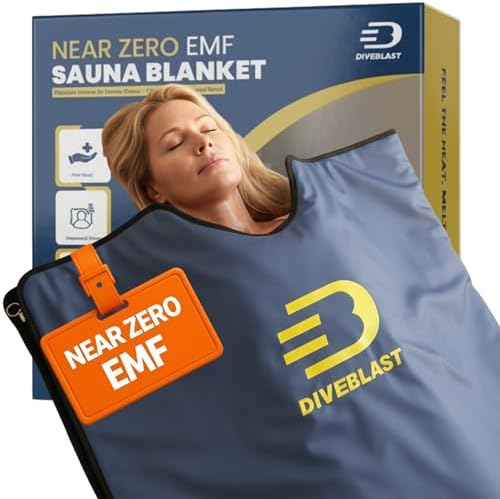
Upgrade pick: DIVEBLAST Zero EMF Sauna Blanket for Weight Loss and Detox, 71x35.6in
 Visit on Amazon →
The footprint here is 71 by 35.6 inches, which is about four inches wider than the budget option. That sounds like a rounding error and it is not. Width is what decides whether your shoulders fit without your arms pinned, and whether you can roll slightly to one side without fighting the material. If you are tall, broad, or you just hate feeling swaddled, the extra width is the reason to step up.
The Zero EMF claim deserves a straight answer. Electromagnetic field exposure is a legitimate concern people raise about any electric heating product, and it is worth caring about. But a label on a product name is not a certification. If EMF output matters to you, look for test documentation, and if the listing does not show any, treat the phrase as marketing rather than proof.
The name also says weight loss, and I want to be blunt about that one. I weigh before and after every single session, so I know exactly what a session takes out of you, and it is water. Session weight loss is dehydration, not fat loss, and it comes back the moment you drink. What I will stand behind is heat, comfort, and a wider build.
Flaws but not dealbreakers: More material means more blanket to fold, and a heavier blanket is harder to hang and dry. Plan where it lives before it arrives, because a blanket that stays crumpled in a bin gets used twice and then forgotten.
Anyone who wants room to move, a longer and wider footprint, and documentation to ask about on the EMF question should look here first.
Set up before you plug anything in
The setup takes five minutes and prevents most of the problems people email me about.
Pick the surface. A firm, flat surface is best. A soft memory foam mattress swallows the blanket and traps heat unevenly. If you are using a bed, a firm mattress with the blanket laid flat on top is workable. A couch works if it is not a deep, pillowy one.
Layer it. Put a large towel down where your body goes, then the blanket over you. If the interior material feels tacky against bare skin, wear a thin cotton layer. Skip synthetic fabrics, which hold heat against skin in a way that gets uncomfortable fast.
Set temperature and timer before you get in. Never climb in and then start adjusting. Every minute you spend fiddling is a minute at a temperature you did not choose.
Put water within reach. A full bottle, not a sip. You will want it when you get out, and reaching for it mid-session is easier than standing up to find it.
Weigh yourself. This is the metric I trust most, because it is the only honest one. Same scale, same time of day, before and after.
The 20-minute session protocol
This is the sequence I use and the one I give clients.
Step one: start lower than you think. Your first three sessions should be at a temperature that feels warm and boring. You are learning how your body responds, not proving anything. Most people jump to the top of the dial on day one and end up lightheaded.
Step two: get in with your head out. Your head stays outside the blanket. Always. A blanket over the face is a breathing and overheating problem, not a spa feature.
Step three: hold 15 to 20 minutes. That is the session. Four times a week is the frequency I run and the one I recommend for a first two months. Experienced users can build toward 30 minutes. I do not recommend going past 45, and I do not recommend falling asleep inside one, ever.
Step four: let the timer end it, not your willpower. This is why auto-shutoff is non-negotiable for me. A blanket that keeps heating because you drifted off is the exact scenario that produces burns. If your controller has a timer, use it every time, even for a short session.
Step five: sit up slowly. Take 30 seconds sitting on the edge before you stand. The dizzy feeling people blame on the blanket is usually just standing up too fast after heat and fluid loss.
Step six: cool down for 10 minutes. Get out, dry off, drink water, and let your body come back to room temperature before you shower or jump into anything else. This is the recovery window, and rushing it is why people feel wrung out instead of restored.
Step seven: rinse and clean. Shower if you want to, and wipe the interior down per the manufacturer's instructions while it is still warm enough to dry. Do not soak the heating elements.
Step eight: weigh out and log it. Write down session length, temperature setting, your before and after weight, and how you slept that night. After two weeks you will know more about your own response than any review can tell you.
Safety rules I will not bend
Heat therapy is low risk when it is controlled and genuinely risky when it is not. These are the lines I hold.
Talk to your doctor before you start if you are pregnant, if you have a heart condition, a pacemaker, uncontrolled blood pressure, or diabetes with neuropathy, or if you take medication that affects sweating or blood pressure. Heat and certain medications do not mix well.
Do not drink alcohol before or during a session. Do not use a blanket while you are sick with a fever. Do not let children use one unsupervised, and do not put a pet inside one, which happens more often than you would believe.
One person per session. If you feel lightheaded, nauseated, or your heart is pounding in a way that feels wrong, get out, cool down, and drink water. A session that ends early is not a failed session.
The mistakes that kill blankets and skin
Buying a dial with no timer. This is the single most common mistake and the most dangerous one. If a blanket cannot shut itself off, walk away.
Cranking it to maximum on day one. You learn nothing about your response and you raise your burn risk. Start low and add heat across sessions.
Abusing the zipper. Do not yank it. Do not zip fabric into it. Do not fold the blanket along the zipper line for storage. Two of my nine blankets died there, and both were zipper failures on otherwise healthy heating elements.
Folding the same crease every time. Fold it differently each time you store it so the heating elements are not stressed in one spot.
Spraying cleaner directly onto the interior. Follow the manufacturer's cleaning instructions exactly. If the instructions read like a dissertation, that is a reason to choose a different blanket, not a reason to improvise.
Skipping the airing out period. New blankets off-gas. Unfold it, let it air in a ventilated room before the first session, and do not judge the smell until it has had a few days.
What this all costs
I will not quote you a price that changes next week. Both blankets above are on Amazon, and both show current pricing on their product pages, so use the link and read the number there.
The math that matters is cost per session. If you use a blanket four times a week for two years, that is a little over 400 sessions. Take whatever price you see on the listing, divide it by 400, and you have your real per-session cost. That is the number to compare against a drop-in sauna, a monthly gym membership you use twice, or a spa day you book when your back hurts.
Add the cheap stuff: a couple of dedicated towels, a water bottle you keep with the blanket, and electrolytes if you sweat heavily. Those run a few dollars a month and they are the difference between a routine that sticks and one that ends with a headache.
The competition and why it lost
A real sauna beats a blanket on almost every measure except one. It is hotter, it has the ritual, and it has the community. It also needs a gym membership, a drive, and 90 minutes out of your evening. The blanket wins on the only thing that decides whether you actually do it: you can be in it four minutes after you decide to.
An infrared cabin is the closest thing to a permanent version of this, and it costs thousands plus the floor space. A sauna suit traps heat without controlling it, which is the wrong direction for safety. A hot bath works, but it uses a bathtub full of water and gives you no timer and no way to log anything. A heating pad is great for one sore shoulder and useless for whole-body heat.
None of these are bad products. They are different tools. The blanket is the one that fits in a closet and runs on your schedule.
The bottom line
Learn the protocol before you chase the temperature. Start lower than feels impressive, hold 15 to 20 minutes, let the timer end the session, cool down for 10 minutes, drink water, and write down what happened. Do that four times a week for two months and you will know whether heat therapy belongs in your routine, which is more than any product page can tell you.
The blanket is not a sauna. It is heat therapy on your couch, and used that way, it is one of the easiest recovery habits to keep.