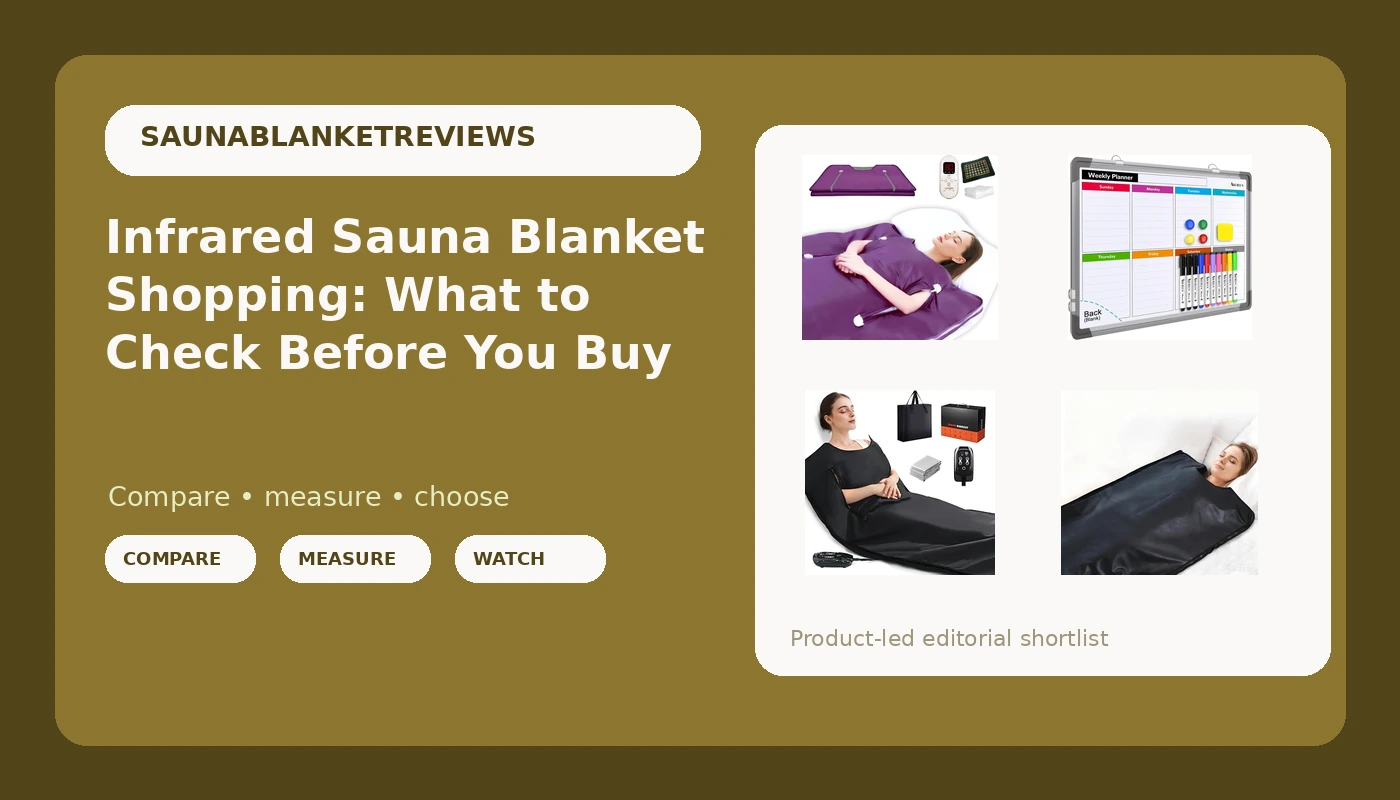
An infrared sauna blanket is not a sauna. That sentence is the most useful thing I can put in front of you before you spend money, because most of the disappointment in this category comes from a mismatched expectation rather than a defective product. A sauna is a room, a ritual, and a block of time you cannot spend doing anything else. An infrared sauna blanket is heat therapy you fold up and slide under a bed, use while you answer email, and finish in twenty minutes without leaving the house.
The problem is that the listings all sound identical. Every one of them mentions relaxation, a top temperature, and vague claims about detox. Almost none of them tell you what you should actually be comparing: how evenly heat spreads across the length of the blanket, how the zipper is built, whether the controls are usable at nine at night without waking the household, and whether the thing turns itself off. I have watched clients buy on price and end up with a blanket that cooks their shoulders and leaves their feet cold. This explainer walks through four listings worth looking at, what each one is genuinely suited to, and how to choose without guessing.
Related: How to Build a Twenty Minute Heat Session at Home →
Quick answer
Match the blanket to the way you will actually use it, then verify three things in the listing before you buy: a timer with automatic shutoff, a temperature range you can live inside rather than a headline maximum, and a zipper that closes without catching fabric. Of the four options here, the Infrared Sauna Blanket with Low EMF and 9 Levels up to 86-176℉ is the one built around granular temperature control, the Natural Jade and Tourmaline blanket is the one with a two-zone double zipper and a remote, the Infrared Sauna Blanket, Relax & Spa at Home is the simplest entry point, and the Weekly Calendar Whiteboard is the piece most people forget: a place to write down what you did and how you slept. None of these is the right answer for every body, and no listing here should be treated as a medical device.
Four useful options
| Model | Best fit | What stands out |
|---|---|---|
| Infrared Sauna Blanket with Low EMF and 9 Levels up to 86-176℉ | Anyone who wants to dial in a specific temperature | Listing describes nine heat levels across an 86 to 176 degree range and low EMF construction |
| Natural Jade and Tourmaline Heat Far Infrared Sauna Blanket with Remote Control for Exercise Recovery Heating Detox 2-Zone Double Zipper Digital Display Portable Saunas for Home Relaxation | People curious about jade and tourmaline layers and a two-zone setup | Two-zone double zipper design, remote control, digital display |
| Infrared Sauna Blanket, Relax & Spa at Home | First-time buyers who want a simple home setup | Straightforward listing positioned around relaxed at-home sessions |
| Weekly Calendar Whiteboard for Wall, Dry Erase Board, Magnetic White Board | Anyone logging sessions and sleep | Weekly layout, dry erase surface, magnetic backing |
The temperature control pick: Infrared Sauna Blanket with Low EMF and 9 Levels up to 86-176℉
Here is the trade-off. A wide range and nine steps are only useful if the heat is distributed evenly across the blanket, and no listing can tell you that. A blanket that reads 150 degrees at the chest and 120 at the feet is not a 150 degree blanket, it is a broken product, and the only way to know is to run a session and pay attention to where the warmth sits. The stepped control is a genuine advantage over a simple high and low switch, because it lets you find the temperature where you can stay for a full twenty minutes instead of bailing out at eight. Verify the timer and automatic shutoff in the current listing before you commit, since that detail is not something I will assume on any blanket.
The jade and tourmaline build: Natural Jade and Tourmaline Heat Far Infrared Sauna Blanket with Remote Control
Two things in that list deserve scrutiny rather than enthusiasm. The first is the two-zone design. If the zones are independently controlled, that is a real feature, because it lets you run the lower half cooler than the upper half and solve the cold-feet problem directly. If the two zones simply describe the physical layout of the heating elements, it is marketing language for a blanket. Read the listing carefully and check which one you are buying. The second is the word detox in the product name. Sweating does not remove meaningful amounts of anything from your body beyond water and electrolytes, and I would rather you buy this for the recovery and relaxation angle, which has a plausible mechanism, than for a claim the product cannot deliver on. The remote is a small thing that matters more than people expect, because reaching down to adjust a control panel while zipped inside a hot blanket is genuinely annoying.
The simple entry point: Infrared Sauna Blanket, Relax & Spa at Home
The trade-off with a simple listing is that you have less information to work with, which cuts both ways. You are not paying for mineral layers or zone controllers you may never use, and for a lot of people that is exactly right. What you also cannot tell from the listing is how the build holds up over a year, and in this category the answer usually comes down to the zipper. Zippers fail before heating elements do. A zipper that catches fabric on the way up will eventually strip its teeth, and once that happens the blanket loses its ability to hold heat around your body. If you buy at the simple end of the market, treat the zipper gently, close it slowly, and keep the fabric clear of the teeth every single time.
The tracking tool: Weekly Calendar Whiteboard for Wall, Dry Erase Board, Magnetic White Board
Why a whiteboard. Because the honest metrics in this category are boring and repetitive, and boring repetitive things need somewhere visible to live. Temperature used, minutes inside, how you felt falling asleep, and whether you woke up at three in the morning. Four columns, seven days, and within a month you have a pattern that no product listing can give you. It costs a fraction of what any blanket costs and it will change how you use the blanket more than an upgrade would.
Prices and availability may change. Product images, names, and retailer links are matched to verified listings. No current price, rating, stock status, or measured result is stated here without current evidence.
Why a blanket is not a sauna, and why that matters for your expectations
A traditional sauna heats the air around you to a high temperature, and your body absorbs that heat from every direction. An infrared blanket works by contact. You lie inside it, the heating elements sit close to your skin through a layer of fabric, and the warmth moves into tissue directly. That difference shapes everything about how a session feels.
Practically, it means a blanket session is more localized. Your core temperature rises, but more slowly and less dramatically than in a hot room, and the effect depends heavily on how well the blanket seals around you. It also means the blanket is doing more work at the contact points and less at the gaps, which is why construction and closure quality matter so much more than the maximum temperature printed on the box.
What you can reasonably expect is a warm, quiet twenty minutes that raises your skin temperature, makes you sweat, and gives you a recovery window after training that feels good and is easy to repeat. What you should not expect is a substitute for a sauna's intensity, or a shortcut to fat loss. Claims about detox and weight loss are marketing. Claims about relaxation, comfort, and a pleasant post-exercise routine have real evidence and real lived experience behind them, and that is enough to justify the purchase on its own.
What the specifications actually tell you
Read a blanket listing the way you would read a used car ad. The headline number is the least informative part.
Maximum temperature. Every blanket advertises a top end. Almost nobody uses the top end for a full session, and a high maximum tells you nothing about the low end, which is where beginners actually live. A listing with a wide range and several steps gives you room to find your temperature. A listing with two settings gives you a coin flip.
Heat distribution. This is the specification nobody publishes. Even heating across the length of the blanket matters more than peak heat, because uneven distribution is what turns a session into a rotation of body parts, chasing the warm spots and avoiding the hot ones. You cannot read this from a listing, so you find it by running a short session at a moderate setting and paying attention to your feet, your lower back, and your shoulders.
The zipper. The most failure-prone component, and the one buyers ignore. Look at how the closure is described, whether there is a double zipper, and whether the fabric is protected from the teeth.
Controls and timers. A temperature dial without a timer is a burn risk, particularly if you are the kind of person who falls asleep warm. Automatic shutoff is the feature I would refuse to go without, and you should confirm it is present in the current listing rather than assuming.
Materials. Jade and tourmaline layers are part of the construction on some blankets. They are described as far infrared emitters, and whether that changes your experience compared with a standard fabric interior is something you can only judge for yourself. It is not a reason on its own to pay more.
- Decide where the blanket will live and how you will lie in it, because a blanket that requires rearranging furniture will not get used.
- Check the listed temperature range and the number of steps, and confirm the low end is genuinely low.
- Confirm a timer with automatic shutoff appears in the listing before anything else.
- Look at the closure: double zipper, fabric protection, and how the opening is described.
- Plan your tracking before your first session, so day one produces a data point instead of a vague memory.
Practical guidance for a safer, more repeatable session
- Start at the low end of the range for your first three sessions and add one step at a time rather than starting where someone on the internet says they run theirs.
- Put a layer of towel between you and the blanket surface, and keep your head outside the closure so you are breathing room air.
- Keep sessions short and consistent, in the fifteen to twenty-five minute range, rather than long and occasional.
- Do not fall asleep inside a blanket. Set a timer on your phone as a backup even if the blanket has automatic shutoff.
- Drink water before and after, and take a break from the routine entirely if you feel lightheaded, dizzy, or unusually fatigued.
- Write the session down the same evening, because memory of how you slept is unreliable by the next afternoon.
Which option should you choose?
Choose the Infrared Sauna Blanket with Low EMF and 9 Levels up to 86-176℉ when temperature control is your priority and you want a wide range with several steps so you can find the setting you can stay in. Choose the Natural Jade and Tourmaline Heat Far Infrared Sauna Blanket with Remote Control when you want the two-zone layout, the remote, and the digital display, and you will actually use a split between upper and lower heat. Choose the Infrared Sauna Blanket, Relax & Spa at Home when you want the simplest version of the experience and do not need zone controls or mineral layers to feel like you got your money's worth. Choose the Weekly Calendar Whiteboard alongside whichever blanket you pick, because a visible log is what turns a novelty into a routine.
One caveat worth stating plainly. Everything above describes features as they appear in the listings, not measured performance. I have not run a lab test on these units, and no listing can tell you how a specific blanket distributes heat or how its zipper will behave in month nine. If you are pregnant, have a heart condition, take medication that affects your circulation or sweating, or have any condition that makes heat exposure risky, talk to a doctor before using any sauna blanket. That is not a disclaimer for legal cover, it is the part of this article I care most about being read.
The bottom line
Buy the blanket that matches your habits, not the one with the loudest spec sheet. If you want control, the nine-level blanket gives you the widest range to work inside. If you want zones and a remote, the jade and tourmaline option is the one to compare against it. If you want simple, the plain blanket is a legitimate choice and not a compromise. Then spend a few dollars on a whiteboard and use it, because the difference between people who get something out of heat therapy and people who abandon it after three weeks is almost never the blanket. It is whether they wrote down what happened and adjusted.